BlakTea
Weekly articles about Blak business
16th October 2026
Does Community Engagement Cover It?
I recently got engaged in a conversation about engagement, specifically, community engagement. We both felt that the term 'community engagement' didn't cover it. What I mean by that is, the term community engagement doesn't really explain what we felt the role should be about.
I'd like to think I'm a bit of a 'community engagement' specialist, but this conversation got me thinking. I used to be a producer/presenter for a program called The Murri Minute, for BushTV. A big part of this gig was 'community engagement.' The gig was to produce good news stories from the community, specifically focusing on local government. My key role was to engage with local mob to produce some great stories. We came, we recorded, we left. The series was a great success, and I felt very proud that I had the opportunity to share some positive stories from our communities to broader audiences.
But yep (there's always a but) when I return to these communities, the stories have faded, and I'm not sure how I feel about that. Community Engagement has become a bit of a catchword over the last decade. The role seemed to be mostly around Indigenous services and programs, but it's sort of grown out of that and spread across a lot of other sectors, under different names like stakeholder engagement, social performance, etc. No matter the title, the role seems to be the same: connect with the community to achieve an identified outcome. And at the risk of being risqué, the outcome isn't necessarily identified by the community. To get a better sense of what I mean, take a look at Matt Damon's film “Promised Land”.
Now, that's an extreme case, but for me, that's what a version of community engagement can look like. Luckily, my approach to community engagement is being upfront and clear about our objectives, so the community can say yay or nay. I haven't had a nay yet, but I'm finding that community members are a lot more scrutinising about the work I'm doing, which is great. As a First Nations storyteller, we have a cultural obligation to ensure story owners retain their rights and control of their stories, so I try to make sure the content I produce can be redacted if the story owner wants that.
It does get interesting though when community engagement is about mining or development. My understanding is that once a project gets green-lit, it takes some turning back, so what's in it for the community? And how does community engagement help facilitate that? I'm sure there's a lot of smarter people than me around who can offer clearer answers.
But yeah, I still don't think the term ‘community engagement’ cuts it for me. The word 'agency' comes to mind, but 'community agency' or 'stakeholder agency' doesn't seem to work either.
Maybe you have a term that might cover it?
Ej
15th October 2026
When to give up!
I guess you could say I'm pretty resilient. And I get to say that because I just don't know how to give up. Playing sports or working, I always felt I had to prove myself. I always thought resilience was a physical thing. You know, run and tackle until you can't walk, labour away until the job is done, always trying to beat the bloke next to you. Proving to him, and everyone that mattered, that I was enough. I was always trying to fix things and make things okay. Gees, I'm glad I don't do any of that anymore. How exhausting!
I now realise resilience is more mental, emotional, spiritual, rather than physical. Which I'm pretty happy with, because my knees just couldn't handle those 5k runs anymore.
Running a business would be the most challenging thing I've ever done. I've mentioned on a number of occasions that I didn't know what I was doing, so I've made my share of mistakes, and business life taught me some tough lessons, these lessons were not necessarily physical. Being in business has tested my emotional and mental health, and even had me questioning my own identity.
A few years ago I went to the wall and had to liquidate a previous business. That was a tough period in my life, where the scars still sting a bit and haven't fully healed. Maybe they never will.
An article in Accountants Daily says 14,152 companies went into insolvency in the 2025–26 financial year. A large percentage of these would be small enterprises, I reckon.
That's a lot of heartbreak.
If my experience tells me anything, it's that a lot of these business owners have put their life and soul into their enterprise, and have come up short. I know. I've been there.
But what to do next?
I come from a long line of doers, so doing something just came naturally. The first thing I started to do was listen. I listened to the people who mattered most to me, and that included me. I stopped listening to those who don't really matter, especially those whose voices had filtered into my thinking. I started doing the things that mattered to me, that I knew were the right thing to do, which is sometimes the hardest thing to do. I rebranded, and I got resilient. I look back now and realise that where I am and what I'm doing is where and who I want to be. I now consider that to be a success, and I'm going okay.
I did get a bit emotional writing this piece, but I hope my writing arrives in front of those who need to be reminded that failure does not define you, it prepares you.
NOTE: I write these articles for my BuyingBlack platform, which hosts First Nations enterprises. I'd love to hear your story of resilience, so I can share it with the BuyingBlack community.
Ej
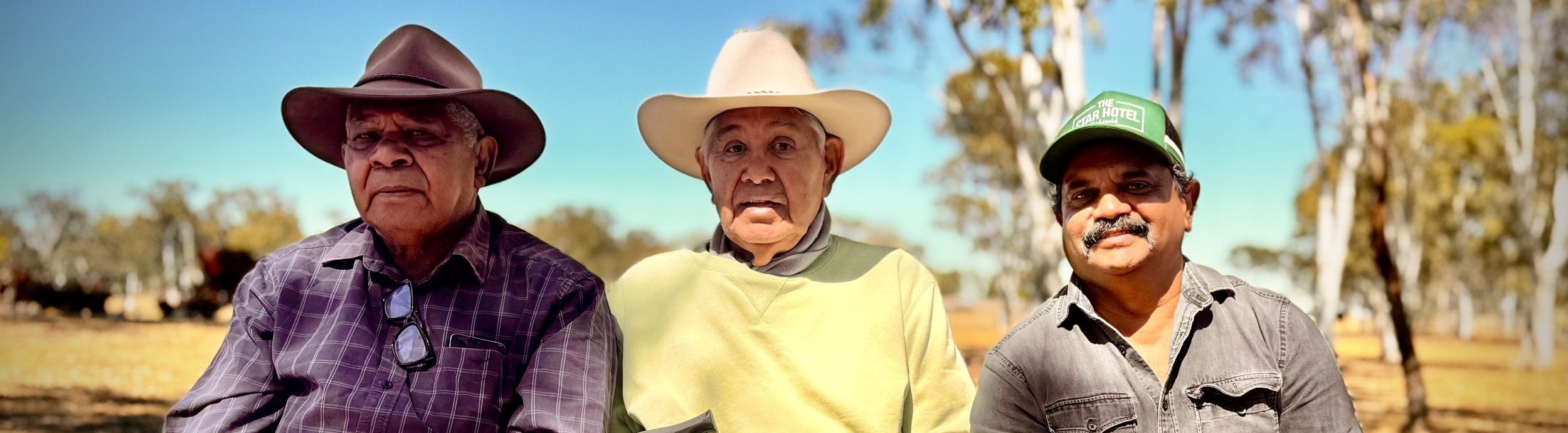
Here sits two wisemen. The other bloke has a cap on.
One talks of doing and saying good things, and the other says we need a time and place to listen to each other. Very simple concepts, but for me, that's what wisdom is, simple solutions to seemingly complex situations.
As our nation spirals into the debate of differences, I'd think listening to each other and doing good things would do wonders for us as a nation. But wise choices don't make the news, and they don't get eyes on screens. Just as common sense doesn't seem to be common, wisdom isn't being listened to. Don't get me wrong, I know age doesn't necessarily convey wisdom, but do we really give our most experienced members of society a go? Do they have a platform? I make it a point to sit and listen to old people, and after we get past the story about walking to school on their hands along a 20km dirt road to keep their shoes clean, we get into the good stuff.
I recall an old fulla I sat with at a thing in Wollongong, who started to talk about civilisation. He offered that civilisation is a word that's losing its meaning, and this wasn't a good thing. He explored the idea of "civil," and how being civil to each other was key to being a successful civilisation, and how performing your civil duty ensures a progressive civilisation.
This idea of being civil, saying and doing good things, and creating a space for listening and understanding, is, I believe, at the core of a successful civilisation. And I came to this conclusion by sitting and listening to some wisdom.
I ended up giving some thought to what wisdom actually is. Google tells us it's a combination of knowledge and experience, but I think there's a third element, humanity. The humanity we share with each other, and how we practice this, is a key ingredient to wisdom. To make a judgement with only knowledge and experience excludes our biggest asset, our connection to each other. Our humanity.
Now, here's a test for you. I got this yarn second-hand, but I love it. This old fulla I know was perplexed as to why young people loved The Simpsons so much. He couldn't figure it out, then it came to him. There's a powerful reason why The Simpsons captured the attention of young people all over the world, and the answer is in the opening sequence and the ending credits.
Do you know what happens in these scenes that is so meaningful for young people? All correct answers get a follow.
Ej
13th October 2026
Wisdom 101
You can't learn it.
You can only experience it.
When you type "wisdom" into the Google, the AI writes that wisdom is the ability to use your knowledge and experience to make sound judgements. Now, I know a bit about sound judgement, because I continuously prove that I'm lacking greatly in this area, despite my obvious level of experience.
18th September 2026
Native Title
‘I'm the Native in Native Title.’
I really didn't have much to do with Native Title until I moved out here. I know it's been around for a while, nearly 30 years here in Queensland. I reported on a couple of Native Title determination announcements as a video journalist for NITV. They were a big deal at the time, and as a media person, I didn't watch much media. But I heard the stories of how people were in fear of losing their homes and properties, where property owners destroyed evidence or kept it quiet, and the fear-mongering. But despite Native Title being around for decades now, no one has been forced out of their homes or off their property.
All that fear and panic for nothing, precious.
I always felt some animosity towards me, and I always thought it was because of my colour. But now I think that animosity is because of who I am. I have an authentic connection to this land through my story and genealogy. That's a pretty strong position to be in. And I can see why that might make insecure people feel a bit nervous, especially those subscribing to the idea of 'Terra Nullius.' And nervous people make me nervous. We're only a small minority here in Australia, but we do get a fair bit of attention, especially when Native Title gets a run in the newspaper. Sometimes it feels like as soon as we look like getting a win, the continent jumps on us from a great height.
I've heard plenty of arguments for and against Native Title, and I've seen firsthand the arguments and family feuds erupt over lineage, land and positioning. And sometimes I wonder if it's all worth it. Then I see the revival of language, the recognition of connection to country, and the economic opportunities. So the jury's out for me. I do often think about this thought an old fella shared with me. He said: once we fought for land rights, and now we have native title. Once we fought for recognition, and now we have reconciliation. Once we had an existence, and now we have our culture.
This stuff makes for interesting viewing, but I'm not sure if you did a pub test on Native Title you'd get a coherent answer. Native Title is one of those things where it makes a big splash with minimum mass. Now, I'm no legal eagle here, but I do understand that Native Title isn't Land Rights and is extinguishable, but I'm happy to take some advice on this.
The one thing I do know is that Native Title provides an opportunity for symbolism, and we all know how powerful symbolism is.
As a Native Title holder, I get to drive my old uncle to an event next week where he'll perform a Welcome to Country. He's asked the organisers not to record his welcome for socials or any media, he recognises how a welcome to country can make some people nervous, and he doesn't need the aggravation.
Wish me luck.
Ej
11th September 2026
The Business of Life
I was out bush this week on a camp talking about leadership with some young people from our town. Well, my uncle did most of the talking, I drove the ute. I love telling people I’ve been out bush, because being out bush could mean anything, and I love it. Cruising along in my Nissan Navara ute, with the faint aroma of engine oil and coolant wafting through the vents, the dubious suspension caressing every bump in the road, and the sound of $2.60-a-litre diesel burning through the exhaust. There’s something romantic about being out bush.
Well, that’s the picture I paint, and there’s some truth in it. But there’s also the reality of driving hundreds of kilometres, mostly on my own, recording stories as an observer, without embedding myself into the intricacies of the communities I’m working with. I’m there to produce stories. To do this to my best ability, I make the time to sit and yarn.
Having just moved back to my home town, which has a population of around 500, I’ve become real good at sitting, yarning and helping out when needed. Don’t get me wrong, we’re not all evangelistic about it, we have our differences and sometimes these differences create friction, but generally we just get on with it.
And we’re not immune to the workings of the world, where the politics of difference takes the lead. Where there’s a line drawn and we’re meant to pick which side we’re on. Left, right. Black, white. Aussie, immigrant. Straight, gay. Burn, grow. Fight, love. I don’t like being told to pick a side, because I’ve learnt life isn’t black and white. To be honest, I don’t know what life is all about, but I’ve learnt recently that doing and saying good things is a good thing to do. I’m saying this because I know there’s someone reading this who’s thinking they need to be more ruthless with their decisions, embellish their posts on socials to get more likes, or be more forceful with their networks to create more leads. I’m not saying don’t do this, I’ve seen how these approaches can bring you success. I’m just saying, if this isn’t you, then you don’t have to do it. Just do you, and do good things, and good things will happen to you.
This leadership camp we recently held out bush involved four students and some local leaders. It was such a diverse group, young, old, black, white, male, female, and we yarned about culture, history, industry. Well, we just yarned about life, really. We sat around the fire, in a circle, in that gold sunset, and talked about life. All of us, this mismatch of humans, sharing our stories about life. It was a good thing to do, where good things were said.
Ej
4th September 2026
Are You Gammon?
‘Building your own personal brand’
So, a few weeks ago I decided to start writing a weekly article. Why? I’m not sure. I do know that I’m enjoying the process. It forces me to look at the environment I’m working in, consider the mechanics within this environment, and then reflect on how I feel about it all. It’s somewhat cathartic.
Having to consider being a First Nations enterprise and evaluating my own experiences being in business usually brings up the things I’d rather forget, like being a certified black fulla, or me and the HAIRYMAN. But the self-critique reminds me of the battles I’ve won and lost, both internal and external. I’ve mentioned the dreaded imposter syndrome in a previous article and owned up to not knowing enough about running a business, and some would think I’m just out here scheduling a weekly existential crisis when I write these articles. But that’s not the case because by the time I get past 500 words, I arrive at a place of clarity.
I have an uncle who’s been through a real crisis or two. He says there’s an emotional process us humans go through when under intense pressure. First there’s fear, then anger, then, hopefully, clarity. He reckons most people can relate to the first two emotions, but not many reach the third. I can so relate to this with this article-writing thing.
First it’s fear “bruz, why on earth are you sharing this personal stuff out to the world?”
Then anger “well, I don’t care if they like it or not, I’m going to put it out there anyway!”
And now, now I think I’m reaching clarity. The self-analysis of my business journey is starting to make sense to me, and I’m starting to realise who I am and what problem I’m trying to solve.
And for me, that’s what a personal brand is. It’s who you are, what you’re capable of, and what you stand for. And if you can stand up in front of your family, community and peers and state this clearly, then you have a personal brand.
Look at me, I’m a black fulla with a hat, who’s good at telling stories, who wants to be the interface between First Nations enterprises and customers.
Firstly, the hat. Some of the best men I knew wore a hat like the one I wear, and it reminds me of my past. I know I’m good at storytelling because people pay me to tell stories. And I know there’s no structural system in place for First Nations micro enterprises to receive certification and connect with consumers, and I want to change that. And that’s my brand statement.
So, to answer the question “Am I gammon?” Well, I’ll leave that up to you.
Just as a side note, for those who aren’t literate in the use of English in an Aboriginal context, “gammon” means untrue, or not genuine. For example, when talking about someone who offers something they can’t deliver, they’re referred to as being gammon.
Ej
28th August 2026
The HAIRYMAN and his stats
You know how when you’re starving for a feed but have no idea what to eat? So, you entertain a number of morsels, trying to create a meal you’re not sure will satisfy? That’s how I felt when we put our first article together for BuyingBlack, “Don’t Doubt The HAIRYMAN.” I was hungry to describe this idea of Indigenous enterprise, a combination of cultural knowledge, belief systems and First Nations values, that I believe surpasses any form of profit-driven pursuit that ever existed. But gees, I’m not sure it worked.
The article quickly became the most sourced item on our website. Even when we hid it, people still searched it out. Just this month, “Don’t Doubt The HAIRYMAN” had 112 views, second only to our homepage’s 161 views. I have no idea why!
My nephew, who does the web stuff, reckons there’s something in this HAIRYMAN article. After giving it some thought, I tend to agree with him.
I based the article on my first film about the same topic. We called it “Black Shadows,” and I loved it. The imposter in me suggests it was the best film I’ve ever made and I should’ve stopped there. The story of the HAIRYMAN has been with me since I can remember, and it’s always fascinated me that more people don’t know it. I’ve found the same people struggle to believe there’s a being that exists in special places and reminds us to treat those places as special. I try to tell the non-believers that this ancient country is made up of places where energy exists, and this energy sometimes manifests into beings that play an important role, like a sort of energy that materialises out of the middle of nowhere, then disappears again. But I’m not sure they’re convinced, until I mention WiFi, then there’s a moment of uncertain clarity.
I spent a lot of my early years trying to convince mainstream Australia that First Nations culture is a rich one that should be valued. But I gave up on that and started telling our stories for us instead. I got a lot more joy out of this approach. This idea of storytelling and enterprise is a simple one, until we try to explain the First Nations experience. How do you explain First Nations skills and knowledge born from a lifetime that most of Australia is still learning about? How do you capture all that in a capability statement?
I really don’t have any answers, because I’m just a storyteller.
But I do know I can lament with you my bleak tale of growing up black in Australia, or I can celebrate with you the vibrancy of my people and our stories. For a 500-word article, I can’t do both, so let’s celebrate. And don’t dare doubt the HAIRYMAN.
Ej
Viewers please be advised video may contain images, voices and names of people who have passed on.
21st August 2026
The Black Business Balancing Act!
Are you an Indigenous business if you don’t employ Indigenous people?
Or don’t sponsor a NAIDOC activity, or worse, don’t attend one? Or don’t even have an Indigenous design for your logo?
My recent article received some attention and a number of responses, which was pretty cool, but it led me to believe there’s more to be done on our current black business certification system and processes.
And I can appreciate why we need a certification process, and why non-Indigenous people would want to be owners of an Indigenous business. Let’s not pretend there’s no financial benefit if you can get through the certification and contracting processes. But there seems to be little acknowledgment of the other benefits of being an Indigenous business. Like being able to employ your own mob. I have my uncle and nephew working for me. Well, they more or less work for themselves and I pay them, and they tell me what they need me to do and if they need anything.
I have an advisory group that provides unsolicited advice on my operations, and an elder in residence who’ll tell me in no uncertain terms if I’m on the right track or not. My community engagement stats are through the roof, only this past weekend I had over 20 people at my place, including elders, mums and bubs, young people, rainbow mob, and leaders from across many industries. Okay, most of them, well, all of them were family. But to be honest, half of my community is family. I’ve been lucky enough to be invited to work with First Nations businesses, organisations and communities across Australia, and the one thing that never comes up is my certification as an Indigenous business. The only time I get asked for my certification as an Aboriginal business is when I’m tendering for a government or corporate contract, which I find exhausting.
The balancing act you perform as an Indigenous business goes mostly unnoticed. How you conduct yourself in this space, the things you support, the people you employ, the knowledge you value, and the people you engage with are the key indicators of a successful black business. But that’s just me. I’m sure there are businesses out there, owned by First Nations people, whose key indicators for success are way different. But who’s to say they can’t conduct themselves as an Indigenous business? Not me!
Each to their own, I say.
But it does pose the question, what is the measure of value for a black-owned business? Is it the deliverables in a contract, or the cultural responsibilities met? Or is it both?
Ej
14th August 2026
Is your story, YOUR story?
‘The price we pay for sharing our stories’
As a First Nations storyteller, I wanted to share my experience with Indigenous Cultural Intellectual Property (ICIP) Rights. Yeah, I stumbled over that as well.
My understanding of ICIP is having your rights to your story acknowledged and protected. Which is odd, because I was told that a mob’s story is their story, and you really can’t tell that story unless the owners of the story are okay with that.
A great example is the Mundagutta (Rainbow Serpent). A lot of mob share this story, even my own, so speaking of this spirit and its role within creation, I’m okay with. But I know that different mobs have their own experience of this story, and in my book, that’s their story. So I can’t share that story, even if they’ve shared it with me.
What makes this ICIP so topical is that at the moment there’s a movement of First Nations entrepreneurs creating micro businesses based on culture. This includes artworks, artefacts and stories. From making earrings to delivering learning programs based on lessons from nature, First Nations men, women and children are monetising their lived experiences as Aboriginal or Torres Strait Islander people. And with this AI hanging around, you never know where your content is going to end up.
I’m no expert, but I reckon back in the day our connections, knowledge and stories made us pretty rich. The world has changed, where finance and capital are key to survival, but the one thing that remains is that our stories are driving our economic success. So having someone rip off our stories could cost us some dosh!
And that’s what I believe is at the heart of this Indigenous Cultural Intellectual Property Rights conversation, our stories.
We come to the market with goods and services based on our stories. Then it begs the question, who is the owner of these stories? Is it the individual? Is it the family or clan group? Is it the communities where they’re from? Or does the story belong to everyone?
And how do we decide?
Well, I don’t have the answer for that, but talking with individuals, elders, families and communities is a great start.
Which is happening now!
This conversation is so important because our stories are the mainstay of our culture. These stories are our reality. And when they’re shared with no controls in place, these stories are at risk.
Not only is there a monetary issue with securing rights and distribution, more importantly, I believe, is the essence of the stories we’re sharing. Are we making them more powerful, or are we stealing them away from their true meaning?
Here in Australia, the film and television industry is largely funded by the Australian Government and broadcasters, and streaming services require rights to the content before screening it. So if you’re producing content for broadcast, at some stage you’re going to have to negotiate rights to your story.
Which I still struggle with!
How can you own a story that belongs to someone else?
We as First Nations people are getting really good at this business thing, and I know that pretty soon we’ll get this ICIP rights topic sorted and we’ll move on, but for now, I’d be interested in your thoughts on securing your rights to your story.
Ej
7th August 2026
Mind your own business!
Business development seemed to me this distant mirage in the entrepreneurial desert. Shimmering away on the horizon, somewhat physical, sometimes translucent, but never solidified into a practical structure that I could understand. Which I found very frustrating. In my sleepless nights I’d hear disembodied voices whispering terms like “financial literacy,” “marketing,” “digital tools,” and the dreaded “networking.”
But thankfully, in Australia the Indigenous business sector is offered a plethora of programs and resources to support First Nations entrepreneurs with their ventures. Regrettably, there are no free four-wheel drives or unaccountably free cash. It’s more like opportunities for seed funding that require a pretty stringent application process, or resources including mentoring and, of course, networking.
In my previous writings I’ve outlined my business journey, which makes me pretty much a specialist on my business, so seeking advice for my own business development felt counterintuitive. But when in Rome… So, I went and sat in networking events, attended development workshops, and even received some mentoring. And despite my initial reluctance, the whole experience was worthwhile. I listened to some good yarns, heard some interesting stories about other businesses and their successes, plus picked up a couple of cool business tips. I can’t recall them off the top of my head, but when I do, I’ll send them through.
What I did learn is that I really don’t know much about business, but I do know a lot about my business, what I do and how to do it. I really couldn’t tell you what should go into a Business Capability Statement, but I do know how to follow a lead and how to take an idea and turn it into an activity with a schedule and budget. Sometimes it feels like I’m a bit unorthodox. I liken it to a Coen bull catcher’s ute, a bit rough, but it comes back with a result. And yes, being told ‘no thanks’ is a result.
As the landscape changes with new technologies, the nature of business will be in such rampant flux that I think keeping up is going to be impossible, so business development tools, resources and mentoring support will become quickly outdated. “So how do we as Indigenous businesses develop adequately?” I hear you say!
Well, I’m a big believer in the ‘do and learn’ technique, where you have a go, learn from the experience, then have another go. It’s not for the faint of heart, but I’ve found that the harshest lessons deliver the best learnings. Now, I’m not recommending my way is the best way, but I do know I’ve learnt so much about my business and myself by attempting to be self-sufficient and self-directed, as an individual and as a business.
But here’s something I’ll tell you for free.
You’ve started a business for a reason, and if you can’t tap into that reason, I don’t think any amount of mentoring, resources or networking is going to help.
In a lot of the literature about business, the term ‘why’ always appears. Now, when I was a kid, ‘Y’ was a crooked letter, and so was ‘Z’ but in business terms, your ‘why’ is the reason you get out of bed and put yourself through torture to run a small business. And if you keep at it, you’ll find it’s one of the most rewarding things you’ll do in life.
Ej
31st July 2026
MONEY, MONEY, MONEY!
Any mob out there struggling with making money from their business? Yep, so am I. So, I did some digging, and I’ve found out that capital is the financial wealth that businesses use to make a profit, and funding is the process of getting this capital. So I’m realising that business just isn’t about doing something you’re good at and getting paid for that something. I innocently thought I was good at a few things, but it soon became apparent that some things I really wasn’t good at, so business didn’t do so well. Being the go-getter that I am, I did some research and came across Karl Marx’s tailor analogy, which just gave me a headache.
The idea of monetising the human experience as a concept hasn’t been around that long. I’m sure them mob who invented the wheel didn’t do it to raise capital, but I’d bet they’re kicking themselves now. Capitalism is so ingrained that it feels like the basis of our civilisation, and all of our progress as humans has a dollar tag on it.
And then I considered that for me, this capitalism thing is hard to grasp because of my upbringing, or DNA memory, and the idea of getting paid for doing what you love seems odd. I’ve found that most First Nations businesses I speak with start with doing something they love, and then someone, usually a family member, suggests they should do that for money. Then it gets interesting. I know of an enterprise that sells their product for just enough money to buy materials to keep making more. And I know of a business that charges a 100% mark-up. That got me thinking, how do you put a value on something you love? Do you compare your product against others? Do you put a price on your time? Or ask the market to set the price? Who knows? I certainly don’t.
I’ve started a few businesses. My first attempt was selling bottles. Yep, 20 cents a bottle. Setting my price was easy, that’s just what the going rate was. My second venture was mowing lawns, but I believe my marketing strategy failed me there, and I couldn’t cut it in that field. Then things got serious, I became a consultant and started making some real money. Well, enough to cover my costs, which wasn’t sustainable, but I loved it. Helping people navigate a problem was gratifying. Then I started a media production venture, which ended up being a tragedy I’m still trying to come to terms with. And now here I am, a storyteller. I don’t have much capital or access to funding, but I do have a pricing structure that keeps me going.
Setting a price on work you love to do can be a struggle. I’ve compared my pricing with others, I’ve checked what the market would pay, I’ve raised and lowered my costs. But it can be done, it just takes some trial and error. And the thing I’ve found is, no one can really put a price on what you do, except you.
Well, that’s what I reckon, what about you? How do you set a price on what you love doing?
Ej
24th July 2026
Are you a certified Blak business?
‘well you might want to read this!’
Imagine living your life as a black fella, being labelled as a black fella, then having to prove you’re a black fulla! Well, here we are. And I wasn’t sure I understood why someone would want to be a black fella that actually wasn’t.
Growing up I wasn’t able to access capital investment against the land my family owned, so I did it pretty tough. My family, like most Aboriginal families where I’m from, lived on the outskirts of town, no car, no power, no running water! And it didn’t get much better from there. Being ‘blak’ in Queensland in the 70’s and 80’s meant regular visits from Social and Health services, checking your head for lice, giving you extra medication and needles, having your poo checked, making sure you were fed, along with a dose of fear mongering. I soon realised our existence was more palpable on the outskirts of town than if you lived in town. So being a black fulla in Australia has its challenges, and wanting to be one if you weren’t didn’t make any sense to me.
Since 1971 the First Nations population of Australia was 115,953, compared to now 983,700. That’s a growth of 4.3% per year versus Australia at 1.4% per year. There’s a few reasons to explain this large growth. Prior to the 80’s, Australia wasn’t good at counting Aboriginal people, then we actually got the opportunity to say we were black instead of having our skin held up next to a colour chart. So now you just tell people you’re a black fulla and it’s happy days. Unless you’re wanting to access grants, funding, capital and services designed for Black Fullas, then it gets interesting. For me, I look like a black fulla so there wasn’t any arguments there, but I had to get an Aboriginal Community Organisation to write a letter to prove my Aboriginality. I had to do this a few times, because I kept losing that letter.
Now if you’re a business owner of a ‘blak’ business, you’ll have to register with Supply Nation to access grants and funding, and to tender for government contracts. The Supply Nation certification is generally accepted across all forms of procurement arrangements in government, corporate and community. When I registered, I was keen to get some more work, but I had to go search for that Aboriginality letter first.
I suppose certification of this nature sets out to ensure that funding and contracts are going to the right people and communities. But we’ve all seen the headlines about cladding, and about blak businesses actually being run by white people who take the profits. And when I hear the stories first hand of the impact on our mob from ventures like Yupla, I have to question the durability of the certification processes we have in place now.
And that leads me to ask, has anyone considered what the certification process was like before? Was it on appearance? Markings on your skin, or the stories you shared? Or was it as simple as answering the question, “who’s your mob?”
Thank you for reading this. I’d love to hear your thoughts.
Ej